| 45A. CAMERAS. | |||
| "Just then the camera fiend produced and leveled a camera" | |||
| IDRIESS 86. | |||
|
A word of caution before writing finis to anything concerning Harold Lasseter, in this case his Box Brownie camera and three rolls of film. Lasseter, Blakeley and Sutherland arrived in Alice Springs late Saturday 19th July 1930 and more or less idled about town and pub until Monday afternoon when Fred Colson cautiously eased the Thornycroft off the rail wagon, meanwhile Lasseter found time to write a bitter letter to his wife Rene and for some photography, "I have been taking several photos along the route and got my film stuck today so I couldn't photo the truck as it came off the rails, I wanted to get to a darkroom and fix it tonight but Fred Blakely has made a date for us to meet the Govt Resident". Confirmation that Lasseter may have owned a camera came on the 12th of November when Ern Bailey wrote to Lasseter's accountant, Edward Edwards, pointing out that, "Mr. Lasseter submitted to me an account for the sum of 47.19.0 certain items of which cannot be allowed by my Company, viz,
|
|||
| Overcharge on telegrams | 4 7 | ||
| Watch | 1 5 6 | ||
| Camera | 12 6 | ||
| Films | 13 6 | ||
|
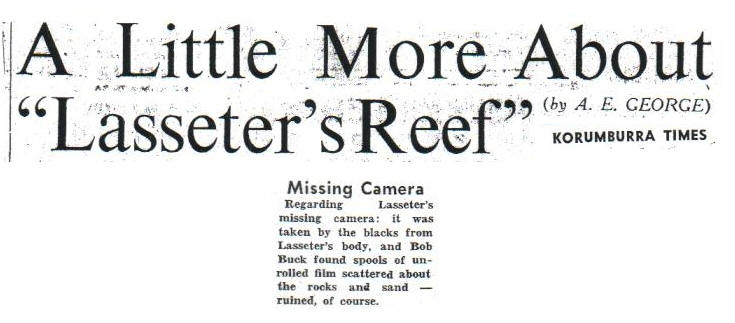
A total of 2 Pounds, sixteen shillings and a penny and that would be deducted from the next Company cheque due to Mrs, Lasseter. The watch becomes an expensive device for teaching Aboriginal kids to count...to 12, the camera photographs the reef and the datum peg and the three rolls of film, twice buried, become fashion accessories, it seems Idriess made better use of that camera than Lasseter. Some thoughts on Lasseter's account, the overcharged telegrams, to whom? W. Johanson, his Bush Mate from Boulder City comes to mind, Johanson would write to Lasseter a couple of days later, Lasseter does not receive the letter, the watch, considering the price would be something similar to a Macquarie Lever pocket watch, said to be robust and reliable timepieces. The camera is a Brownie #0, 12/6 country price, 11/3 in the City and three rolls of film at 4/6 each, a shilling for the film, a shilling to develop and 2/6 for twelve prints, potentially 36 photographs and not one to be seen because Lasseter buried "evidences of the truth". By the way, the camera fiend was Philip Taylor, an excellent photographer, with a keen eye for detail and setting and apparently equipped with something more sophisticated than a Brownie, many of his photos appear in Lasseter's Last Ride, without acknowledgement or remuneration. the original entry can stand for the moment as not a great deal has changed, history still records a broken camera, returned to Lasseter's family in 1942, belly bands, and no photos of that fabulous gold reef, but what has changed is the possibility that Lasseter did leave Alice Springs with a camera and perhaps not for the purposes of photography but setting the scene for future events, to be recorded in his Diary. ~~~~~~~~~~~~~~~~~~~~~~~~~~~~~~~~~~~~ The Sydney Mirror reported on 29/04/31, that amongst other items, Bob Buck had found a broken camera beside Lasseter's body. Which makes this is a convoluted and difficult entry. But it may have some merit, for cameras are not the innocuous device they first appear to be. Both Idriess and Buck risk some exposure on the subject. Blakeley, Taylor, the Captain and naturally Coote carried cameras on the first C.A.G.E. expedition, and all of them left some record of the journey. But none mentions Lasseter having a camera. Blakeley did not find one when he raided Lasseter's tin trunk, and if he did have a camera he apparently did not take any photographs of his companions, or of the expedition from Alice Springs to the time he departed Illbilla with Paul Johns, this is most unlikely….if he had a camera !! But first lets dispense with the mundane; the Captain took an excellent group photograph of the men at Pantas well and it is this photo that appears in Hells Airport. Coote records that during the scramble to board the vehicles the Captain left his camera behind, and it was later found and returned by a carrier named McFarlane. In his memoirs Blakiston-Houston does not mention misplacing the camera or his good fortune in recovering it. Taylor was an enthusiastic photographer and several of his shots appear in Lasseter's Last Ride, although many more were lost in the fire at Ayers Rock. Coote liberally illustrates his book with his own photos but Blakeley's photos were accidentally burnt and this may explain the unillustrated format of Dream Millions. On the day the C.A.G.E. expedition was preparing to leave Ai Ai Creek for Illbilla, Michael Terry and his mates were searching McKay's landing strip a few miles north west of Ayers Rock for the camera belonging to Morrison, the press photographer with McKay's Expedition. Morrison had lost his camera out the door of the aircraft as it was taking off, Terry met the McKay expedition on its return to Adelaide and Morrison perhaps in jest and probably with faint hope asked Terry to have a look for it. To everyone's surprise Ted Colson, (Freddy's brother) found the undamaged camera in a clump of spinifex and was photographed on the last unexposed film. Morrison's camera was eventually returned intact. Now lets examine Lasseter and his camera very closely, for Sullivan believes the man never took a photograph in his life much less own a camera. Lasseter was prolific with his pen on a wide range of subjects and his written record is readily available, but none of his letters are accompanied by photos in order to illustrate the subject. In short there is not one photo extent anywhere taken by Lasseter's hand, and for a widely travelled fellow with an interest in many things the lack of photos is more than passing strange. And for a man who took every opportunity to write to his family, (and we have to take Idriess's word for that) it would be reasonable to expect the letters to be accompanied by photos elaborating points of interest along the journey from Alice Springs. Especially of his companions, the spectacular scenery and the Aboriginals at Illbilla. And if Lasseter did have a camera he would have had ample opportunity to return the exposed film to Alice Springs or Sydney with Coote or Colson as Taylor apparently managed to do, and for a few pounds more Idriess would have snapped up those photos along with the diary and letters from Lasseter's impoverished widow. It is difficult to believe that Lasseter saved his entire stock of film for that ficticious reef somewhere in the Petermannns. Lasseter Apparently carried a goodly supply of film, various reports have him burying three rolls in a sand dune near where the camels bolted, a couple more in the cave by the Hull River, the roll that was prised from the camera by the aboriginals and another three rolls were found by Neville Harding in 1950, buried in a tin under a camp fire opposite the cave. These films were probably planted by Cutlack in 1948 as part of his Lasseter fraud, but Harding and Cutlack are dealt with elsewhere. It stretches the imagination to think that the thin metal of the film reels would survive 24 years of rust, besides why would Lasseter in his straightened circumstances be carrying a now useless camera as he struggled his way to the Olgas. In all, it seems that Lasseter had at least a dozen rolls of film and naturally not one photo exists of his Petermann journey or any other part of the expedition.
My Dear Sullivan, Received your letter of the 23rd and although I am of a like mind regarding Lasseter and his camera, I must remind you that your evidence is circumstantial. The only thing that saves it from mere suspicion is the involvement of Idriess and Buck, anything from these two is worth a second glance. True, it is mentioned in press reports towards the end of April 1931, that Buck had found a broken camera close by Lasseter's body and the Aboriginal women were wearing the film as 'belly bands', now that sound like pure Buck!!. But, when Walter Gill met Buck at Hermannsburg on 3/5/31 he only produced a set of dentures, a revolver and a diary as evidence that he had found and buried Lasseter, Gill goes on to say that Buck "thought he had a damaged camera some-where in the camel packs". Buck then relates the first or second version of 'belly band', story, this time it's hair decoration. Gill did not actually sight that camera and I doubt if the Aboriginals would go near that "devil box" or have the knowledge to unravel the film. And under the circumstances I cannot see a strip of film lasting two days much less two months no matter how it was used for decoration, (brings up that 78 day problem again). Of course it would suit Idriess's purposes very nicely to have Buck find a camera belonging to Lasseter, the camera, no matter its state of repair, can be cited as 'evidence' that Lasseter photographed the reef and datum peg, thereby confirming its existence and the destruction of the evidence. Sulli', like the film, their story is starting to unravel. Yes, put the lot together and it all sounds like Buck 'n' Idriess to me, but you cannot deny that there was a camera amongst Lasseter's personnel effects in the tin trunk when it was finally returned to the family in 1942. The right question may be, whose camera was it??, I wonder if Buck had a storeroom of broken cameras similar to the storeroom of broken assorted revolvers that Gill found while staying at Middleton ponds during mid May 1931 ??. So you reckon Lasseter started without a camera but somehow dies with one, I'll think about it.
Yours,
© R.Ross. 1999-2006 Gill Walter. Petermann Journey 5. Idriess Ion L. Lasseter's Last Ride 86. 115. Mitchell Library, Reel, CY/12035. ML MSS 5152.Lasseter Family, papers re Lasseter Expedition 1930-1932. |
|||